
Diabetes Friendly Beer & Lager
If you are managing diabetes and looking at what beer fits, the useful information is rarely on the can. Most beer labels give you the alcohol content and nothing else.... Read more
WINE
WINE
SHOP BY WINE TYPE
SHOP PRE-MIXED CASES
SHOP BY DIETARY REQUIREMENT
BEER
BEER
If you are managing diabetes and looking at what beer fits, the useful information is rarely on the can. Most beer labels give you the alcohol content and nothing else.... Read more
If you are managing diabetes and looking at what beer fits, the useful information is rarely on the can. Most beer labels give you the alcohol content and nothing else. No carbohydrate figure, no sugar figure, nothing to work with.
Every beer on this page lists its carbohydrate content, sugar content, calories and ABV, so you can see exactly what you are looking at before you buy. What follows explains what those numbers mean, what Diabetes UK advises, and how the beers here compare with mainstream lagers.
Diabetes UK advises people with diabetes to follow the same guidance as everyone else on alcohol, which is no more than 14 units a week spread over three or more days, with several drink-free days.
They also make a point worth repeating, because it runs counter to what people assume: low-sugar beers and ciders are not automatically a better choice. Products marketed as low sugar are often higher in alcohol, and alcohol carries its own considerations for anyone managing blood glucose. Their guidance is to look at the whole picture rather than a single number on the front of the packaging.
That is the approach taken with this collection. Every beer here is listed with its carbohydrate content, its sugar content, its calorie count and its alcohol strength, so nothing is hidden behind a marketing claim.
What we cannot do is tell you what is right for you. That is a conversation for your GP or diabetes team, who know your medication, your targets and your history. What we can do is make sure you have the actual figures in front of you when you have it.
Beer is made from malted barley. Brewing converts the starch in the grain into fermentable sugar, and yeast turns most of that sugar into alcohol. Whatever the yeast does not convert stays in the finished beer as carbohydrate.
How much is left is a brewing decision rather than an accident. A standard lager stops fermentation with a fair amount of residual sugar, which gives body and mouthfeel. Extended fermentation converts more of it, leaving less carbohydrate in the glass.
This is why two lagers at identical strength can differ fivefold in carbohydrate. Nothing has been removed or replaced. The beer has simply been fermented for longer.
| Beer | ABV | Carbs | Calories |
|---|---|---|---|
| Standard lager, 330ml | 5% | 10 to 12g | Around 140 |
| Standard lager, pint | 5% | 15 to 20g | Around 240 |
| Cider, 330ml | 4.5% | 15 to 20g | Around 180 |
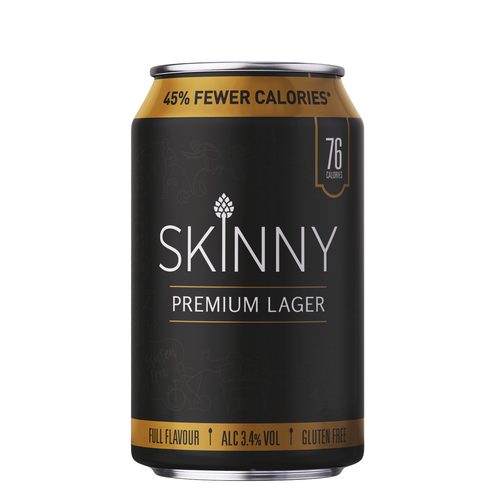
| Lowest carb beer in this collection | 3.4% | 0.8g | 84 |
The gap is the point. A pint of ordinary lager can carry more than twenty times the carbohydrate of the lowest option here, at a higher alcohol strength and nearly three times the calories.
Carbohydrate per serving, not per 100ml. A figure per 100ml looks reassuringly small until you multiply it by 568 for a pint. Always check what the number refers to.
The alcohol strength. Diabetes UK's point about low-sugar products being higher in alcohol is a fair one, and worth checking before assuming a beer is a lighter option overall.
Whether the figures are published at all. UK labelling rules do not require nutritional information on alcoholic drinks, so most brands publish nothing. If a retailer will not tell you the carbohydrate content, that is worth noting in itself.
Serving size. A 330ml can and a pint are not the same drink. Most published figures use 330ml.
What beers can diabetics drink?
There is no single answer, because it depends on your medication, your targets and how alcohol affects you personally, which is why Diabetes UK recommends discussing it with your healthcare team. What we can tell you is that the beers on this page range from 0.8g to 7.3g of carbohydrate per serving, against 10 to 12g for a typical 330ml lager, and every figure is published on the product page.
Which beer has the least carbohydrate?
In this collection, the lowest is 0.8g of carbohydrate per 330ml serving at 3.4% ABV. For comparison, a standard 330ml lager typically carries 10 to 12g, and a pint carries 15 to 20g.
Is low sugar beer better for people with diabetes?
Not necessarily, and Diabetes UK specifically caution against assuming so. Low-sugar beers and ciders are frequently higher in alcohol, which brings its own considerations. Looking at carbohydrate, sugar and alcohol strength together gives a fuller picture than any one figure alone.
Does beer raise blood sugar?
Alcohol affects blood glucose in ways that vary between individuals and depend on medication, so this is a question for your GP or diabetes team rather than a drinks retailer. Diabetes UK have detailed guidance on alcohol and blood glucose management.
How many carbs are in a pint of beer?
A pint of standard 5% lager contains roughly 15 to 20g of carbohydrate and around 240 calories. Stout and ale vary, with Guinness Draught sitting lower at around 10g per pint due to its lower alcohol strength.
Is beer or wine lower in carbohydrate?
Dry wine, by a considerable margin. A 125ml glass of fully dry wine contains under half a gram of carbohydrate, against 10 to 12g for a 330ml lager. Our low sugar wine collection lists the figures for every bottle, and there is more detail in our guide to wine and beer compared.
All low calorie beer
Low carb and keto beer
Low sugar wine
Gluten free wine
The information on this page is nutritional, not medical. If you are managing diabetes or any other health condition, speak to your GP or healthcare team about alcohol. Guidance for people with diabetes is available from Diabetes UK and the NHS.
Read lessKeep up to date with all of our latest products & promotions. We regularly run promotions and discounts, along with listing new and exciting products.
We never share your information! View our Privacy Policy