
Low Calorie Beer
Cutting carbs but refusing to cut out beer? Welcome to DrinkWell! We like to say that are beers are light, not sh!te, because packed with those hoppy flavours that you know and love, and without the unnecessary extras.
WINE
WINE
SHOP BY WINE TYPE
SHOP PRE-MIXED CASES
SHOP BY DIETARY REQUIREMENT
BEER
BEER
Cutting carbs but refusing to cut out beer? Welcome to DrinkWell! We like to say that are beers are light, not sh!te, because packed with those hoppy flavours that you know and love, and without the unnecessary extras.
Beer is the most calorie-dense drink at most bars, and until recently there was very little choice about it. A pint of standard 5% lager carries around 240 calories and 15 to 20g of carbohydrate, which is roughly a slice of takeaway pizza in liquid form.
The beers in this collection run from 60 calories a bottle upwards, at full drinking strength rather than watered down. Every one lists its calorie count, carbohydrate content and ABV, so you can see what you are getting before you buy.
There is no legal definition, which is worth knowing before you trust the phrase on a label. In practice, most people use it to mean under 100 calories per bottle or can, against around 140 for a standard 330ml lager and 240 for a pint.
Two things determine the number, and they pull in different directions.
Alcohol carries around 7 calories per gram, which is nearly as much as pure fat. In most beers it is the single largest contributor. A weaker beer will almost always be lower in calories for that reason alone.
Residual carbohydrate carries around 4 calories per gram. This is the grain...Read more
Beer is the most calorie-dense drink at most bars, and until recently there was very little choice about it. A pint of standard 5% lager carries around 240 calories and 15 to 20g of carbohydrate, which is roughly a slice of takeaway pizza in liquid form.
The beers in this collection run from 60 calories a bottle upwards, at full drinking strength rather than watered down. Every one lists its calorie count, carbohydrate content and ABV, so you can see what you are getting before you buy.
There is no legal definition, which is worth knowing before you trust the phrase on a label. In practice, most people use it to mean under 100 calories per bottle or can, against around 140 for a standard 330ml lager and 240 for a pint.
Two things determine the number, and they pull in different directions.
Alcohol carries around 7 calories per gram, which is nearly as much as pure fat. In most beers it is the single largest contributor. A weaker beer will almost always be lower in calories for that reason alone.
Residual carbohydrate carries around 4 calories per gram. This is the grain sugar left behind when fermentation stops. Extended fermentation converts more of it into alcohol, which brings the carbohydrate down without reducing strength.
The best low calorie beers use the second approach. They ferment for longer rather than simply diluting, so you get a beer that still tastes like beer.
Figures per bottle, as published by each brewer.
| Beer | Calories | Carbs |
|---|---|---|
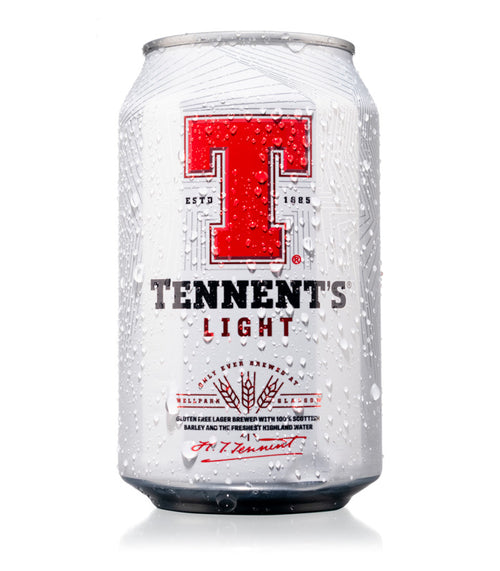
| Tennent's Light Lager | 60 | 0.7g |
| Marstons Resolution Ale | 88 | 3.5g |
| SkinnyBrands Lager | 89 | 3g |
| Omission Light | 99 | 3g |
| Kona Light | 99 | 3.15g |
| Standard lager, for comparison | Around 140 | 10 to 12g |
Tennent's Light is the lowest calorie beer we stock, at 60 calories and 0.7g of carbohydrate a bottle. That is less than half the calories of a standard lager and around a fifteenth of the carbohydrate.
If you would rather try several before committing, the mixed cases give you a handpicked selection across the range.
The terms get used interchangeably and they measure different things.
Low calorie is driven mostly by alcohol strength, because alcohol contributes more calories than anything else in the glass. A weaker beer will generally be lower in calories.
Low carb is driven by how completely the beer was fermented. A strong beer fermented fully dry can carry very little carbohydrate while still being reasonably high in calories, because the alcohol is doing the work.
Most of the beers here qualify as both low calorie beer and low carb beer, but if you are counting carbohydrate specifically, the figure to look at is the carb column rather than the calorie one. Our keto beer collection filters for the lowest carbohydrate options, and there is more on this in our guide to keto alcohol.
Worth separating these too, because the difference is what most people are actually looking for.
Low alcohol beer reduces the strength, typically to 0.5% or below. Fewer calories, but a different drink.
Low calorie beer keeps the strength and reduces the carbohydrate through longer fermentation. Same beer, fewer calories.
There is also a counterintuitive catch with alcohol-free versions: producers often add sugar to replace the body that alcohol provided, so the calorie saving can be smaller than the label suggests.
For context, using published figures for a pint:
None of those would be considered a low carb beer. The gap between a mainstream pint and a genuine low carb beer is a factor of five or more.
Guinness surprises people, because it looks heavier than it is. The creamy texture comes from nitrogen in the pour rather than sugar, and the strength is lower than most premium lagers.
There is a fuller breakdown in our guide to calories in beer.
What is the lowest calorie beer?
Of the beers we stock, Tennent's Light at 60 calories and 0.7g of carbohydrate per bottle. Across the wider market, most beers marketed as low calorie sit between 80 and 100 calories, against around 140 for a standard 330ml lager.
How many calories are in a low calorie beer?
Typically between 60 and 100 per bottle, depending on strength and how completely the beer was fermented. A pint of standard 5% lager contains around 240.
What is the best low carb beer?
Tennent's Light at 0.7g per bottle is the lowest carb beer we stock. Most low carb beer sits between 2g and 3.5g per bottle, against 10 to 12g for a standard 330ml lager and 15 to 20g for a pint.
Does low calorie beer taste different?
It depends how it was made. Beers that reduce calories by dilution taste thinner. Beers that get there through extended fermentation keep their body, because nothing has been taken out, the sugar has simply been converted into alcohol.
Is low calorie beer better than wine?
On calories per serving, usually. A bottle of low calorie beer at 60 to 99 calories sits below a 175ml glass of wine at 130 to 160. Per millilitre, wine is more calorie-dense because it is stronger. Our comparison of wine and beer calories covers this properly.
Why do beer labels not show calories?
UK labelling rules do not currently require nutritional information on alcoholic drinks above 1.2% ABV, unlike food and soft drinks. Most brands publish nothing. Every product on this page lists its figures.
Low carb and keto beer
Low calorie wine
Low sugar wine
Mixed cases
Keep up to date with all of our latest products & promotions. We regularly run promotions and discounts, along with listing new and exciting products.
We never share your information! View our Privacy Policy